Analysis
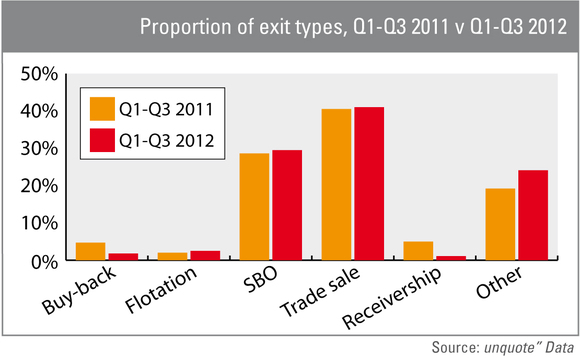
Secondary buyouts have seen their share of the exit market rise, while trade sales hold steady, according to the latest figures from unquote” data.
However, exit numbers are set to end the year sharply down from last year, falling 63% in the first three quarters of 2012.
Looking at the first nine months of this year, secondary buyouts accounted for 29.5% of all exits recorded by unquote" in volume, up from 28.6% over the same period in 2011.
However, the total number of secondary buyouts has fallen by two thirds. It has been suggested that secondary buyouts may be easier to complete than complicated trade sales or flotations in the current market environment.
Trade sales increased in market share slightly, from 40.5% to 41%, though the total number fell from 180 to just 114.
On a brighter note however, the number of companies going into receivership has dropped significantly. In the first nine months of 2011, a total of 22 private equity-backed businesses went into administration, representing a substantial 5% of all exits. This has fallen to just 3 over the same period in 2012, accounting for 1.1% of the market.
It is unclear why the number of failing companies in portfolios has fallen so dramatically given the return of recession. It may be that portfolios were largely cleared out by the wave of failures last year, or perhaps the eruption of the eurozone crisis last year led some businesses to slim down and ensure they were able to more effectively weather the storm should the economic situation decline further.
Flotation numbers were only slightly changed, falling from nine in 2011 to seven this year, though market share rose slightly to 2.5%.
The sharp decline seen in overall exit activity is indicative of the current market. Private equity investors cannot access the financing needed to complete secondary buyouts. Trade buyers, while supposedly cash rich, are either unwilling to pay the price needed or are remaining cautious and saving their money for a rainy day.
Still, the fall in deals ending in failure suggests portfolio companies are largely healthy, they just can't command the kind of price that is needed. But profitable exits are a requirement to convince investors that the model works. GPs need to fundraise at this stage in the cycle, but if they cannot demonstrate their ability to exit profitably then it will be tough to convince LPs that private equity is a worthwhile investment.
Your comment will be moderated before publication.
search unquote.com
Industry news
Pantheon has teamed up with non-profit organisation Sponsors for Educational Opportunity (SEO) in a bid to encourage ethnic minority college undergraduates to pursue a career in private equity.
Triton Partners is thought to have closed its latest fund, Triton Fund IV, on €3.3bn, setting a record for a German-based GP.
Private equity firm Langholm Capital has put crisps brand Tyrrells up for sale, according to a source close to the situation.
LDC and L Capital, the private equity fund of luxury goods giant LVMH, are among investors interested in acquiring a stake in British fashion retailer Joules, according to the Independent.
More from unquote
Latest Analysis
Event
Updating your subscription status
Digital Editions
Events
Visitor Comments