

The UK's Green Investment Bank - not yet a done deal
A week ago, the UK government announced the pre-election budget plans for 2010, which included the idea of a Green Investment Bank (GIB). But despite these positive intentions and the backing of private investors, it is far from a done deal; even if it does get off the ground it would probably not become a reality for a year or two, writes Francinia Protti-Alvarez.
More on Investments
Change of mind: Sponsors take to de-listing their own assets
EQT and Cinven seen as bellweather for funds to reassess options for listed assets trading underwater

BHM Group builds on PE strategy, eyes European medtech and renewable energy acquisitions
Czech Republic-headquartered family office is targeting DACH and CEE region deals

Trind VC plans up to five early-stage investments in next six months
VC has deployed around 10% of its second, EUR 55m fund and plans to invest in up to 40 startups

Credo Ventures sees activity uptick, plans further deals in 2023 with EUR 75m fourth fund
Czech VC firm's latest vehicle is around 50% deployed and expects to make 25-30 deals in total
Latest News

Stonehage Fleming raises USD 130m for largest fund to date, eyes 2024 programme
Multi-family office has seen strong appetite, with investor base growing since 2016 to more than 90 family offices, Meiping Yap told Unquote

Permira to take Ergomed private for GBP 703m
Sponsor deploys Permira VIII to ride new wave of take-privates; Blackstone commits GBP 200m in financing for UK-based CRO

Partners Group to release IMs for Civica sale in mid-September
Sponsor acquired the public software group in July 2017 via the same-year vintage Partners Group Global Value 2017
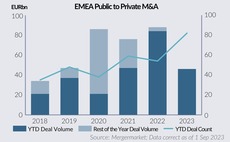
Change of mind: Sponsors take to de-listing their own assets
EQT and Cinven seen as bellweather for funds to reassess options for listed assets trading underwater