

Secondaries in primary position

Secondaries activity breaks $20bn barrier for the first time.
At long last, secondaries have made the noise the industry has been awaiting for years, with 2010 seeing more than $20bn of transactions done. The peak – more than 2.5x 2009's $7.5bn – was reached as primary fundraising for private equity funds hit a six-year low of $200m for 2010. The figure was comprised of a number of transactions worth over $1bn each, according to research from specialists Cogent Partners and Triago.
Increased pricing may have driven activity, with Cogent putting buyout fund pricing at 89.8% of NAV for the second half of last year, up from 86.4% in the first six months of the year. Triago recorded a climb of 31.3% since a Q1 2009 low.
The actual transaction prices may be a bit higher, since the data comes from first-round bids Cogent received on funds between last July and December, rather than actual selling prices, which are often higher.
According to Triago, the pricing increase is more to do with increased productivity and low wage growth than it is down to any major expansion in sales. Cogent also suggests the 20% increase in the S&P index during the second half of last year was a contributing factor.
Whatever the reason, the rise in pricing could top out or decline if prospects for economic growth don't improve, since a buoyant economy helps boost deal multiples. Triago points out that multiples on mega-deals averaged 9.1x EBITDA in Q9 2009, an 18% premium on the ten-year average, according to S&P's LCD, and last seen during the boom years of 2007 and 2008.
Assets being sold are increasingly funded, according to Cogent: the average fund marketed in the second half of last year was 76.8% called, up a bit from the previous six months. The number of unfunded positions, on the other hand, has fallen steeply, with only 6.6% less than 25% funded, against 26% in H2 2009.
Still growing
Last year's record is unlikely to be the last: Triago estimates that 2011 will see $25bn recorded since new regulation will incentivise certain owners to offload their private equity assets. Among them are banks, insurers and other regulated financial institutions which find themselves impacted by the Volker Rule and Solvency II.
Sellers are also positively encouraged: according to Triago, many sellers in 2010 did so to actively manage their portfolios, not to alleviate liquidity issues. This was because they owned (and sold) positions in large buyout funds, which benefited from strong pricing increases, thereby allowing the limited partners (particularly pension funds) to benefit from selling at a minimal discount to NAV so as to accelerate their shift in allocations.
More on LPs

EU FSR could impact PE fundraising with potential rise in ‘clean funds’
FSR could lead GPs to create funds without foreign LPs; red tape around sovereign wealth funds likely

Golding adds insurance expertise with hire for institutional clients team
Tim Ickenroth joins as director with prior experience at BNP Paribas and UniCredit

Unquote Private Equity Podcast: PE perspectives from Berlin
Unquote’s Min Ho and Rachel Lewis digest the key takeaways from this year’s SupeReturn

EU Foreign Subsidies rules hold specific challenges for PE
Sovereign wealth funds and pension funds commitments may trigger EC attention under new EU foreign subsidies regulation
Latest News

Stonehage Fleming raises USD 130m for largest fund to date, eyes 2024 programme
Multi-family office has seen strong appetite, with investor base growing since 2016 to more than 90 family offices, Meiping Yap told Unquote

Permira to take Ergomed private for GBP 703m
Sponsor deploys Permira VIII to ride new wave of take-privates; Blackstone commits GBP 200m in financing for UK-based CRO

Partners Group to release IMs for Civica sale in mid-September
Sponsor acquired the public software group in July 2017 via the same-year vintage Partners Group Global Value 2017
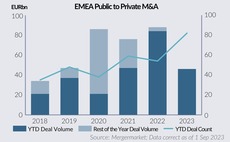
Change of mind: Sponsors take to de-listing their own assets
EQT and Cinven seen as bellweather for funds to reassess options for listed assets trading underwater