

"Healthtech revolution is coming" health secretary tells BVCA Summit
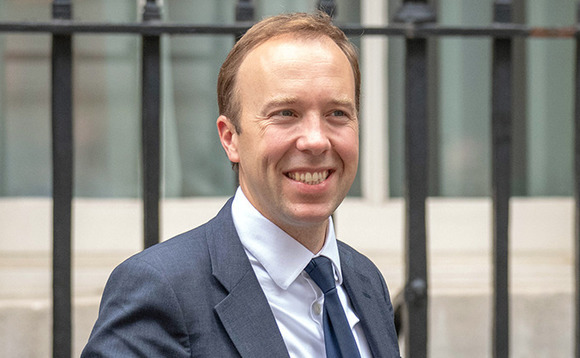
Private equity and government figureheads called for cooperation to reinvigorate the UK's medical technology sector, speaking at a summit held by the British Venture Capital Association today. Oscar Geen reports
Health secretary Matthew Hancock opened the British Venture Capital Association (BVCA) 2018 summit this morning by inviting the UK private equity industry to engage with his strategy to transform healthcare technology.
"I know there are problems on my side of the fence, but everyone should know that the healthtech revolution is coming to the NHS," said Hancock. "We are leading the world in several areas already; this change is coming and we want you to be part of it."
"We have an increase in budget, which is exciting, and we have allocated £500m in the last couple of months to help short term funding requirements," Hancock said, and continued to briefly summarise the main tenets of his transformation strategy. "No doubt, making sure the workforce is better supported, motivated and bigger is important, [therefore requires a] big cash injection for getting and training people. I want as much as possible for the uplift to go into prevention rather than the acute system, because that makes it sustainable, and the thing that I really see as long-term opportunity is innovation and technology."
However, Hancock did not specify where exactly this innovation should be targeted. "Don't listen to me," he said. "Listen to what the NHS needs."
Next up was Matthew Brockman of Hg, who highlighted Hg's own contribution to healthtech innovation through investments like Allocate Software. "We're not building care homes, but we are doing repeat investments in healthcare tech companies, which builds industry knowledge, and we are constantly thinking about how we can continue to leverage that knowledge."
On broader trends in the industry, Brockman highlighted the need for a corporate strategy as well as an investment or fund strategy at the level of the GP. If Hg's portfolio was a single entity, it would be the third largest software company in Europe, with €4.2bn in revenues and 20% growth, Brockman said. Highlighting JAB Holding's consolidation play in the coffee market, recently supplemented with the acquisition of Bridgepoint's Pret-A-Manger, Brockman pointed to "industrial scale" as the defining feature of the current direction of private equity.
However, this was not a view unanimously shared by the morning's speakers. Dana Haimoff of JP Morgan said that 80% of its private equity investments are in funds of less than $1bn. "The reason we do that is because we think there's more return. Obviously there's more risk but there are also more opportunities to drive returns."
Livingbridge's Shani Zindel used statistics from Unquote Data to support her point that opportunities in the lower-mid-market were plentiful, and to explain the firm's decision to stick to this deal bracket. "The more obvious way to grow is to raise a bigger fund and do bigger deals, but our heritage was in the lower-mid-market; that's where we grew up and what we're good at. So we decided to grow, but retain our deal size."
New model
Zindel said that in building out the platform at Livingbridge, the team had to abandon certain traditional private equity concepts. "We had to stop relying on the traditional rainmaker model; it's a much more collaborative effort," she said, adding that on the deal-doing side this is difficult for some LPs to fathom. "It drives LPs mad because they want to do attribution analysis, so they ask 'Who did this deal?' and we can't answer that because it could be anything from four to 10 people."
Introduced as a philosopher of private equity and referred to by the BVCA's Tim Haines as Vision's Wittgenstein, Julian Mash of Vision Capital also had critique of the standard fund model: "One [problem] is arbitrary timetables, and the other is how incentives work. If a private wealth manager came to you and said these stocks are great but we're selling them, you would wonder why. The classic PE fund model forces us (not Vision, but others) to sell things after a while."
Mash sees the current trend of innovation and specialisation in the secondary market as a solution to this problem. "Continuation, extensions and refreshment of capital are all ways of addressing this timetable constraint. It's incredibly rational and more will be done. It's just a shame it's solving a problem that might have been structured out in the first place."
Latest News
Stonehage Fleming raises USD 130m for largest fund to date, eyes 2024 programme
Sponsor acquired the public software group in July 2017 via the same-year vintage Partners Group Global Value 2017
Stonehage Fleming raises USD 130m for largest fund to date, eyes 2024 programme
Czech Republic-headquartered family office is targeting DACH and CEE region deals
Stonehage Fleming raises USD 130m for largest fund to date, eyes 2024 programme
Ex-Rocket Internet leader Bettina Curtze joins Swiss VC firm as partner and CFO
Stonehage Fleming raises USD 130m for largest fund to date, eyes 2024 programme
Estonia-registered VC could bolster LP base with fresh capital from funds-of-funds or pension funds