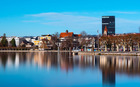

Berlin: A venture giant in the making
The venture capital scene in Germany’s capital has made a huge leap forward in recent years, and is seemingly developing into a mature ecosystem. Katharina Semke reports
According to unquote" data, Berlin's early-stage and expansion deal volume in 2011 stood at 49, with a combined value of €266m, rising to 92 transactions worth €995m in 2015. The near doubling of Berlin's venture activity shows the scene is growing up thanks to various drivers.
A recent report by EY regarding German venture capital and startups praised the city's positive development: "The city is second to none in terms of attractiveness and has outpaced other European tech centres such as London, Stockholm or Paris." It is indeed catching up to the continent's main startup hub: while Berlin's deal volume was 44% that of London's in 2011, that figure reached 56% in 2015, despite continuing growth in the UK.
Berlin itself is a major draw for founders and potential employees, as Dörte Höppner, chief executive of Invest Europe, observes: "The soft factors such as affordability and wide array of cultural offerings make Berlin a cool place to live, which is very important for the startup scene's success." A steady influx of young creatives and cheap rent, combined with a rising number of job opportunities, has helped create an infrastructure, which has in turn developed a momentum of its own over the years, and continues to draw more and more founders and venture capitalists to the city. It now has an entrepreneurial environment that is ahead of the rest of the country. However, the large funding increase in recent years suggests there has to be more to it.
Investors from abroad are increasingly targeting Berlin, says Florian Heinemann, managing director of Berlin-based venture player Project A Ventures: "For investors from the UK or the US, the valuation-substance ratio of German startups is very attractive." Especially in the US with its larger investor-density, valuations have gone through the roof in recent years, making investments pricier. Backing European startups, for example in Berlin, has therefore become more popular. US investor Turn/River Capital, for instance, made its first foray in the German capital in November 2015, when it backed software testing business Test IO with $5m. The EY report pointed out a financing gap regarding rounds of €3m up to €10m. Since many national VCs still lack the ability to contribute larger tickets, more capital inflows from US VCs is good news.
For investors from the UK or the US, the valuation-substance ratio of German startups is very attractive" – Florian Heinemann, Project A Ventures
Sowing the seed
These days Berlin also boasts an active and liquid business angel scene, which is a sign of the city's ever-increasing maturity, particularly as these groups of private investors do not simply materialise; rather, they come into being over time. A large proportion of them are made up of previous founders who have successfully grown their own startups. Having come into wealth after exiting their businesses, they are now investing in young businesses themselves. Project A's Florian Heinemann is one of them. He co-founded JustBooks/AbeBooks, which was sold to Amazon in 2008, and is now part of the city's business angel network. "Berlin has a group of about 50 to 100 people who are able to invest a sum between €20,000 and €100,000 on short notice. They help developing a company with money and know-how to a stage where VCs can enter," Heinemann says.
Höppner believes the German capital has outpaced the country's other startup hubs, making investors wanting to settle there: "Most new VCs in Germany are opening their offices in Berlin." Indeed, BlueYard Capital, a new early-stage investor, which closed its first fund at $120m in January 2016, has set up shop in Berlin. The firm is also confirmation that Berlin's venture scene is increasingly cosmopolitan. It was founded by Irishman and former Earlybird partner Ciaran O'Leary, together with two Americans – Jason Whitmire, who was also a partner at Earlybird, and Chad Folwer, general manager of 6Wunderkinder, a German startup acquired by Microsoft in June 2015.
Room for improvement
Although Berlin and European venture capital in general have come a long way in recent years, the trend among startups to relocate to the US, especially in the technology sector, does not look as though it will go away any time soon. Better funding opportunities and higher valuations are one reason for this, with market-size being another major factor. "Europe aims towards having a single market, but it is not there yet. Once this aim is achieved, our startups would not need the US market any more to reach a critical mass and to roll out globally," Höppner says, also pointing out that the whole of Europe has a larger gross domestic product than the US.
Although Heinemann agrees on the unbroken importance of the US market, he observes a decreasing need to make it their main focus: "Technology companies will always have to service the American market, but the centre of gravity, where the activities are focused, does not have to be shifted to the US anymore."
Latest News
Stonehage Fleming raises USD 130m for largest fund to date, eyes 2024 programme
Sponsor acquired the public software group in July 2017 via the same-year vintage Partners Group Global Value 2017
Stonehage Fleming raises USD 130m for largest fund to date, eyes 2024 programme
Czech Republic-headquartered family office is targeting DACH and CEE region deals

Stonehage Fleming raises USD 130m for largest fund to date, eyes 2024 programme
Ex-Rocket Internet leader Bettina Curtze joins Swiss VC firm as partner and CFO
Stonehage Fleming raises USD 130m for largest fund to date, eyes 2024 programme
Estonia-registered VC could bolster LP base with fresh capital from funds-of-funds or pension funds