
French PE urged to help mend country's social divide
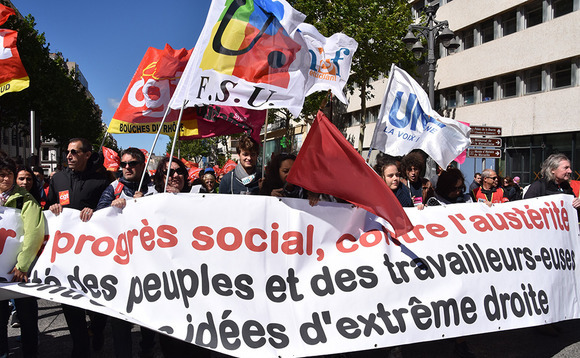
Speaking at the annual Afic conference on May 18 in Paris, panellists suggested the time has come for France's private equity sector to take on a new task: helping the country heal its fractured society. Alice Tchernookova reports
France's private equity sector has been riding a positive wave over the last two years. In 2016 alone, an aggregate €24.7bn was gathered through fundraising, according to unquote" data – a record amount that significantly exceeds the €9.8bn collected in 2015. Overall, total deal value in the buyout, expansion, early-stage and PIPE spaces in the country hit a high of €22.3bn – the largest figure since 2006 – across 314 deals.
Trust has also been regained in the sector with local investors, as most limited partners have been increasing their allocations to private equity. According to AFIC's official data, last year insurance companies invested an estimated €2.134bn in funds, compared with €1.328bn the previous year; funds-of-funds increased their contribution from €895m to €1.082bn, and so did family offices and individuals (increasing from €1.608bn to €1.903bn), banks (from €550m to €1.293bn) and pension funds (from €522m to €1.590bn).
There has to be a common, shared vision between the fund and the company, where both are strategic partners and move on from the positions of funder and beneficiary" – Renaud Dutreil, LVMH Moët Hennessy Louis Vuitton
In the face of such positive results, the sector must keep moving forward, and set itself new targets. Renaud Dutreil, chair of LVMH Moët Hennessy Louis Vuitton and a former minister who acted as Emmanuel Macron's representative within Afic during the presidential campaign, said: "Bringing financial support to businesses is no longer enough – that single link cannot help reconcile the financial world and the working world.
"Investors now have to foster trust within target companies. There has to be a common, shared vision between the fund and the company, where both are strategic partners and move on from the positions of funder and beneficiary."
In the same spirit, Afic recently drafted a series of proposals – part of a 16 measure-programme submitted during the electoral campaign – to encourage a friendlier and more inclusive approach on the GPs' side. Among these were the ideas of promoting the regime of free shares allocation for company employees, first introduced by Macron but recently called into question by the previous government; putting in place a system of shared profit, whereby any potential capital gains made on a future exit could profit all those willing to invest in the business (including employees); and finally, the idea of establishing a clearer and more transparent regulatory frame for management packages, which determine the management team's profit through an LBO transaction.
Overall, these measures aim to bring the interests of GPs and target companies closer, encouraging a more cooperative relationship between them.
A "last chance" mandate
Macron's mandate, according to Dutreil, will be that of the "last chance". He said: "There is a big wait-and-see mode for what is about to come over the next few months, with a need to deliver results immediately for the new man in power. Or else, the way will be open [for extremist parties]."
But although for France's more privileged social classes, the president's intentions are clear, it is elsewhere that the real difficulties lie ahead. "The delicate, painful topic, is the divide that exits between those who are successful and those who feel like 'the losers' of a globalised world," Dutreil added.
He identified four categories within the so-called "losers": the unemployed; the country dwellers; the workers; and the civil servants. "Those four categories currently fall under the same umbrella in that they all feel that for them, there is no horizon, no prospects. Macron's real challenge is therefore to give back hope to these people, and to make them feel like they can also take advantage of the developing world."
In this context, the best move for the private equity sector is to do its own bit to help the future new government achieve this. This, several panellists suggested, should be done in two ways: by continuing to contribute to the country's overall economic development and stability, generating more growth; and also, by creating more jobs.
According to Afic's data, the private equity sector helped create an extra 256,349 jobs between 2010-2015 – an effort that should be maintained, members of the association agreed. Afic president Olivier Millet said: "Macron's mandate will be successful [on the employment side] if he manages to create between one and two million jobs during his time in power; as company shareholders, our role in that will be absolutely key."
Closing the conference, Dutreil added: "Today, a strong pressure is exerted on the business and finance sectors by both the extreme right and left parties, who are making a 'pincer attack' on us; in the face of this, we must display resilience and unity."
Latest News
Stonehage Fleming raises USD 130m for largest fund to date, eyes 2024 programme
Sponsor acquired the public software group in July 2017 via the same-year vintage Partners Group Global Value 2017
Stonehage Fleming raises USD 130m for largest fund to date, eyes 2024 programme
Czech Republic-headquartered family office is targeting DACH and CEE region deals
Stonehage Fleming raises USD 130m for largest fund to date, eyes 2024 programme
Ex-Rocket Internet leader Bettina Curtze joins Swiss VC firm as partner and CFO
Stonehage Fleming raises USD 130m for largest fund to date, eyes 2024 programme
Estonia-registered VC could bolster LP base with fresh capital from funds-of-funds or pension funds