

New Era protests: a warning for private equity?
Growing levels of wealth inequality in the UK should prompt a deeper, more long-term consideration from private equity, writes Alice Murray
According to figures from the Office of National Statistics, the wealthiest 1% of Britons own as much as the poorest 55% of the population. While this might not immediately appear to be an issue for private equity, recent events have made it clear the industry needs to start thinking carefully about both the wealth it amasses and its social responsibility.
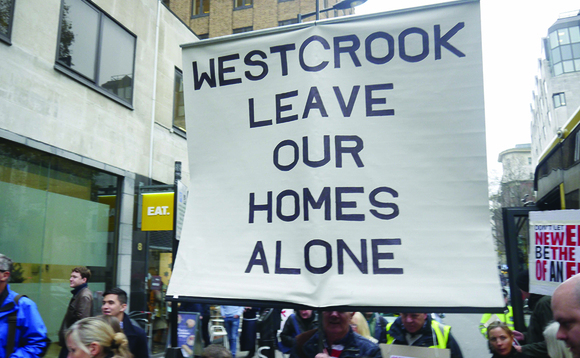
Protests outside the London offices of real estate investor Westbrook Partners in early December, which attracted a great deal of media attention, highlight the dangers of ignoring the potential social impact of investments.
New brand of politics
Residents of the New Era estate in east London protested outside the property investor's offices in the capital following the firm's purchase of the housing site. Westbrook's investment threatens to evict 93 families currently living in the property. Even without comedian-turned-political-activist Russell Brand's appearance, this kind of activity was bound to capture the media's attention as more and more column inches are dedicated to social injustices. And each time a story such as this emerges, national press will undoubtedly divulge more and more about the "unfair" and "greedy" practices of investment managers.
The protest made its way to 10 Downing Street, where campaigners handed over a petition carrying 294,000 signatures to the prime minister and London mayor to intervene.
Judging by announcements made in the Autumn Statement, it would appear that UK politicians are already taking note of the public mood. With an announced increase in the investment limit for Social Investment Tax Relief to £5m and a nod towards taxing management fees as income tax where firms have been claiming capital gains, the direction in which regulators are headed has been clearly signalled.
Haven help them
Clamping down on tax avoidance and evasion is already firmly on the cards in the run-up to the election. While the full implications of Osborne's plans to mop up extra cash through taxation of management fees are not yet clear, what is important at this point is we are likely to see the spotlight turning towards the private equity industry as the election nears.
Fortunately, something can be done. The BVCA is currently putting together its manifesto, as is customary in the run-up to a general election. This year, the document will focus heavily on social impact investment and private equity's unique position for carrying out these deals. Furthermore, the association is morphing its citizenship committee into an Impact Investment committee.
As the mudslinging moves into full swing ahead of the vote, UK buyout houses would do well to promote how socially responsible they are, rather than letting the main focus be on the industry's handling of tax.
If Westbrook had assessed its purchase of the New Era estate in terms of being a socially responsible investor, would it have gone ahead with the deal?
Before the protests on 1 December, Labour's Sadiq Khan called on Westbrook to sell the property to a social landlord to avoid evictions.
Sound as a pound
While the investment case for buying New Era, in terms of its risk/reward profile, is perfectly sound – after redeveloping the building, the owners will be able to charge as much as three times more in rent – the third dimension of investment, social impact, would have significantly changed the profile of the deal.
However, it would appear that the very public reaction to Westbrook's investment has had the desired effect. According to the Guardian, the real estate investor is on the verge of transferring ownership of New Era to an affordable housing provider. The move comes after discussion between Westbrook and London deputy mayor Richard Blakeway, and Hackney mayor Jules Pipe.
Regardless of what season it is, the asset class must take into account the social impact of its investments. That is not to say private equity ought to be making social impact investments, rather it simply needs to consider the wider implications of potential deals.
Latest News
Stonehage Fleming raises USD 130m for largest fund to date, eyes 2024 programme
Sponsor acquired the public software group in July 2017 via the same-year vintage Partners Group Global Value 2017

Stonehage Fleming raises USD 130m for largest fund to date, eyes 2024 programme
Czech Republic-headquartered family office is targeting DACH and CEE region deals

Stonehage Fleming raises USD 130m for largest fund to date, eyes 2024 programme
Ex-Rocket Internet leader Bettina Curtze joins Swiss VC firm as partner and CFO

Stonehage Fleming raises USD 130m for largest fund to date, eyes 2024 programme
Estonia-registered VC could bolster LP base with fresh capital from funds-of-funds or pension funds